I have ADHD, and growing up organization was never a strong suit of mine.
I distinctly remember having a binder, one single binder, for EVERYTHING growing up. This binder was not clean, this binder was not contained, this binder had hundreds of loose pieces of paper in it, most of which got lost at some point or another. If I didn’t have it in front of me, I tended to forget it existed. This manifested so badly, that I even forgot, for months, to tell my parents about the upcoming school science fair, and I needed to do a project. They found out the Friday before the fair, and were (rightfully) very upset with me. I had 2 days to do a project. Guess what I did?
Volcano.
Today, I’m a project manager managing 4 different projects, 2 direct reports, 3 clients, and the staffing plan for around 40 employees at the company, all at once. No more are papers blowing in the wind, with no thought given to the direction or organization strategy. Now, everything is neat and tidy in my Obsidian notes and project workbooks.
It took a lot of time to get here, and oddly enough, the little plastic miniatures of Warhammer 40k were part of that growing process. Through Warhammer, I learned that simplicity can help with organization and tracking. It was my own way to get to “Keep It Simple, Stupid.”
For those of you who don’t want to read through my 40k lore and just skip to the lessons I learned, scroll down to Tim the Enchanter from Monty Python and the Holy Grail.
What is Warhammer 40k?
Warhammer 40k is a tabletop wargame where you build an army out of little plastic (and sometimes resin) miniatures, then push them around a table trying to blow each other up with a lot of dice rolls and rulebook math. It’s set in a grimdark far future where humanity is barely hanging on, and the galaxy is locked in permanent war across three broad camps: the Imperium (humanity’s massive, fanatical, deeply bureaucratic empire), Chaos (renegades and demons who serve dark gods and generally want to watch it all burn), and the Xenos (everyone else — aliens, bugs, robots, and other things that would very much like humanity gone). Every playable army falls into one of those three buckets, and depending on which faction, and which sub-faction within it, you pick, the game can play wildly differently.
It’s an absolute blast. Check it out.
Tyranids: My First Love, My First Struggle
Back in… 2002? ish? My older cousins pulled me aside and showed me a massive paper backed tome. This tome was 3rd edition rules for Warhammer 40k. They told me I should play this game with them, and excitedly pointed at page 30 of the book, and said “You should be the Tyranids.”
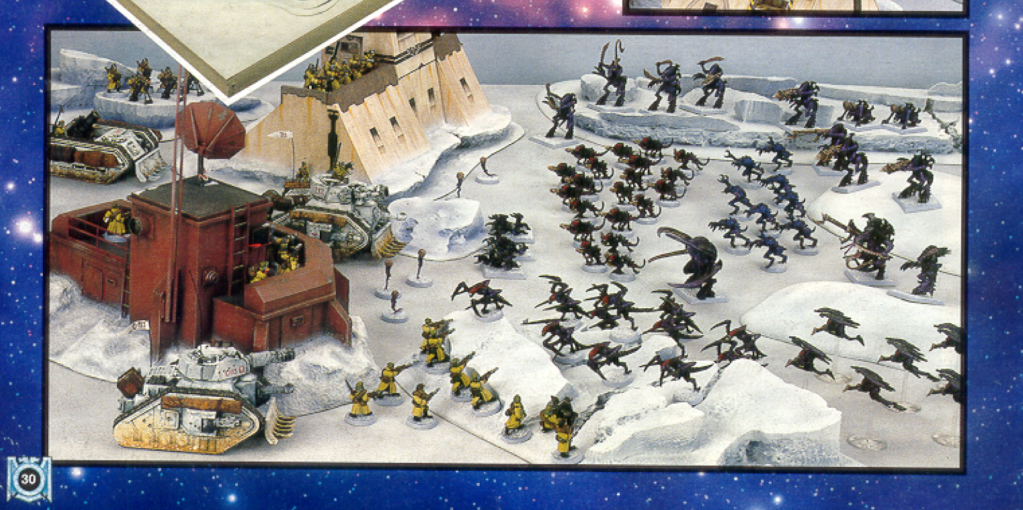
My older cousins were cool, and I liked bugs, so why not! I ended up starting a Tyranid army. Upon my first game, I noticed how much I loved seeing the anxiety a 10:1 model ratio instilled in my opponents. They actually even made mistakes dealing with the chaff of the army rather than dealing with the big models that actually mattered. It was from this that I discovered my love of armies that force opponents to take real world morale tests…but this is beside the point.
I barely remember 3rd or 4th edition of 40k, but I do remember that Tyranids needed a lot of synergy. If certain smaller models were near certain bigger models, they got bonuses. Tyranids in 3rd were all about “synapse” ranges, instinctive behavior tests, and what felt like a dozen little rules that only mattered if you remembered which bug was near which other bug. My brain never really remembered these rules, and as such I always did rather poorly in the game. I loved the models (still do), but I spent more time squinting at the rulebook trying to remember if my gaunts were in range of the Warriors.
I didn’t have language for it then, but that was my first real world brush with complexity in gaming.
Orks: Because They’re Care Free and Hilarious
I played Tyranids all through 3rd and 4th edition. After a while, my cousin and I did a trade. Some of my spare models (3rd edition starter sets with Dark Eldar and Space Marines) for some of his home made Orks. Whenever I played against him, I always got the sense that he was just having an absolute blast blowing up the battlefield as well as himself. Ork bikes back then were OP as heck, and he had tons of them. Orks just seemed like a ton of fun to play. Orks lore was “Their tech works because they believe it works”, which is just hilarious.
Once 5th edition rolled around, I truly got deep into the ork mindset and play style. I started having a LOT of fun playing and managing the chaos of an Ork Horde. They have a gun that opens a portal into hell, chuck goblins (grots) through it at their enemies, and, after having passed through hell, the goblin, now often without their sanity, explode inside the bodies of their enemies. Scatter dice were a thing back then, so depending on your luck, it could hurt you as much as it hurt the enemy. It’s insane, its stupid, its awesome.
I think the Orks are my favorite army. I definitely had the most fun with them. They still had some complexities, scratched the “I love hordes” itch, and were chaotic to play. I did keep running into issues remembering everyone’s unique brand of chaos, so I still struggled.
Space Marines: Because of One (two) Model(s)
Eventually, the horrors of 7th edition passed, and we landed with 8th edition. This introduced bigger Space Marine (see: Poster boy) models called “Primaris”. I remember thinking “No way would I ever buy these models…they’re space marines!”…then I saw a Primaris Sergeant, and a intercessor (dude with gun) that looked amazing. Then these two handsome models distracted me and proceeded to steal my wallet.
I ended up with a Salamanders Space Marine Army, the first one I have ever (almost) completely painted! Their lore of “be nice” in 40k grim dark was a breath of fresh air, I really liked how hard they hit and how few models I needed to keep track of. I really enjoyed the more simple approach to game play they offered.
However, I found I still struggled with the sheer number of options the army had. Being the poster boys, they have a significant number of options to choose from. Ain’t nobody got time to filter through all these options to figure out the best combo to play games. I still needed something else…
Realizing I Didn’t Have a Chaos Army — Enter World Eaters
At some point in 2025, I, as an adult, looked at my shelf and realized I had 2/3 of the main categories of armies. I had 2 alien armies, 1 Imperial Army, but no Chaos. This got me thinking, what chaos army could I use that would be dead simple, fun to play, interesting lore wise, and leave me with less choice paralysis?
More importantly, I was now an adult. I had less time to play, which meant a longer time between playing games, which meant forgetting rules. I needed a dead simple army that would still be effective, that was also fun to play. Also, a sweet backstory lore wise wouldn’t hurt.
I picked World Eaters, and this time I actually knew why I was picking them: they are, by design, dead simple. Their whole army-wide rule boils down to one sentence — charge into combat. The World Eaters’ whole schtick is “Insane melee berserkers.” That’s it. No web of triggered abilities, no “if this unit did that thing three turns ago, this other unit gets a bonus” nonsense. Charge. Hit hard. Repeat. Blood for the Blood God.
This was the first time I actually had some intentional thinking behind an army choice. World Eaters…
- Have limited models to choose from
- Have 1 primary mechanic, kill in close combat.
- Hit hard
- Don’t have too many models to keep track of on the field.
This section is getting rather long and rambly, so I’ll move on to the point of all this.

The Point
Looking back, I picked every army to fit the brain I had at the time.
- Kid-me wanted cool bugs and didn’t care about the rules or the complexity.
- Teenage-me wanted a fun time and to cause chaos. (This still tracks)
- Young Adult-me simultaneously wanted something that looked great, and had plenty of options for how to combat a situation.
- Adult me, doing adult things like starting a family and having a full time job, just wants a cool army that requires minimal thinking. I just want to play. 🙂
I like to think that each army taught me something about myself.
- Tyranids taught me that visually awesome things can have a complexity tax.
- Orks taught me to always have fun and embrace chaos, BUT fun and chaos come with a price.
- Space Marines helped me grow into a bit more finessing my approach to problems.
- World Eaters taught me that there is a beauty in simplicity.
I find this pattern of Tyranid > Ork > Space Marine > Chaos kind of interesting… we gravitate towards hobbies based on where we are in life
Humans are pattern recognition machines, so maybe this is nothing. Maybe I’m just noticing a coincidence and calling it a personality trait. But I like to think it’s less “nothing” and more “learning.” Every hobby choice was a little data point about how my brain actually wants to work, long before I had the vocabulary to describe it. Getting older hasn’t changed what I like — it’s just given me the language to explain why I like it.
 I’m Just a Guy with AI
Leave a comment